.png?w=128&h=128&auto=format)
.png?w=256&h=256&auto=format)

.png?w=128&h=128&auto=format)

.png?rect=0,205,1614,1211&w=1600&h=1200&fit=min&auto=format)

The 2026 Fintech Agenda: Year 1 of a “Decade of Change”
Possibilities where Elevation is actively spending time on in 2026

Financial Services continues to be a steady compounder in India. Listed financial services market capitalization reached ~$1.3 trillion, continuing to represent ~25% of India's public market capitalization. Within this, the listed fintech market cap scaled to $45 billion+ (~3% of the overall FS market cap). In parallel, private fintech funding has regained momentum, growing to ~$2 billion in CY25 ($1 billion in 2024, $1.9 billion in 2023), as scaled-up fintechs raised large growth rounds.
The stage for this dramatic fintech value creation over the last decade was built on two pillars: Mobile and DPI (Digital Public Infrastructure). A decade or two ago, buying (and paying for) ‘things’ online felt reckless; many users swore they’d never type a credit-card number into a browser. Today, we tap twice on a phone and think nothing of wiring rent across town. We’ve always underestimated the impact of platform shifts (PC, Internet, Mobile, Cloud, etc.) on the delivery of financial services. However, these shifts have profoundly impacted Access, Experience, and Efficiency. As we approach the next platform shift, it seems certain that it will bring big changes across financial services.
We believe that AI is a secular tailwind that will fundamentally expand the frontiers of Fintech and Financial Services. Modern AI does two things its predictive forebears couldn't: the capacity to converse like humans and, critically, "think" with the complexity and nuanced reasoning of a knowledge worker. This opens up the ability to reshape the operations of incumbent banks and financial institutions and rethink how consumers engage with financial services. But challenges exist - regulatory frameworks remain unclear, BFSI needs hand-holding to make AI projects successful, and fundamental consumer behaviour change is required to leverage AI fully.
2025 started to make the realm of possibility real, demonstrated by compelling examples across different financial products globally and in India. However, we believe that working through the opportunities and challenges of AI in Financial services is, "A decade of change, (and not a year of change).” (h/t: Andrej Kapathy).
With that background, these are themes we are actively spending time on in 2026. Reach out if you are thinking or tinkering with ideas in these domains.
1. Reimagining the Distribution of Financial Products That Require Consultative Selling
Penetration of most financial services remains low in India, especially products that require hand-holding, personalization, and trust in the sales journey - i.e,. Insurance and Wealth. AI-native distribution platforms in both these domains can help improve both user experience and expand the surface areas of addressable audience. (due to extremely efficient cost structure and this lower cost to serve)
There exists an opportunity to re-imagine and massively expand the addressable markets of PolicyBazaar, Prudent/NJ, 360 One, etc.
2. Enable Agentic Payment Ecosystems
India has been a leader in payments innovation and will likely lead the way for AI-led commerce and customer services. We are already witnessing new models emerging across AI concierges and conversational commerce, which will require agentic payments to deliver a full-stack buying experience. This will need financial service enablement at the backend and presents an opportunity to re-imagine the payment infrastructure, including authorization, validation, fraud monitoring, and compliance layers.
Companies like Razorpay, Juspay, etc. were built on the tailwind of digital commerce. Agentic commerce creates the next tailwind for value creation in payments.
3. Accounting, Audit, and Other CFO Functions
US CPA firms are undergoing a talent crisis; combined with people-cost arbitrage, this drives heavy outsourcing to India (and other geographies like the Philippines). AI enables massive leverage to this back-mid office function, at significantly lower costs and faster turnarounds. We believe that both software and outcome/services models will have a place - i.e., there exists an opportunity to sell into the Big 4, and simultaneously challenge them (and the numerous mid/small size BPOs/KPOs in India).
4. Voice AI
Voice (human-led) remains the primary interface that most people use to interact with their financial services. This is evident from the massive call centers and branch infrastructure that financial institutions run across sales, customer service, collections, etc. 2025 is the year voice AI came of age, both technically (human-like, low latency, etc.) and product-wise (move from voice bot to voice-led agents that can enable task completion). This space will likely see multiple winners, each building deep vertical solutions with voice at its core, but deeper workflows, intelligence and memory layers built on top.
5. AI-led Workflows at Financial Institutions
Many workflows at financial institutions have two things in common - large amounts of unstructured data and defined workflows. This, combined with large opex costs, creates a perfect storm for AI-led disruption of internal workflows. There exists a unique opportunity to convert “dumb” software to intelligent agents that get the work done. The opportunity set is far-reaching and covers multiple domains, including Fraud/Risk, Credit Ops, Collection and Legal Workflows, Compliance, Underwriting, etc. However, challenges exist - of explainability, compliance and enterprise-wide behaviour shifts; hence, this requires teams that are deep domain experts and willing to commit to a “decade of change”.
6. Personal Financial Concierge
Money matters are complex - too many choices, opaque terms and costs, sometimes misaligned incentives of consumers/distributors, and most importantly, psychological factors influencing decision making. In parallel, the AA ecosystem has solved data availability at an unprecedented breadth and depth. This creates a perfect set-up for an AI-led personal financial concierge to help users manage their personal finances better by providing contextual advice across spend behaviour, investments, and other financial products. There have been numerous attempts in the past to build personal finance management products with mixed success; AA+AI has now created the perfect foundation to do this at scale.
If you are thinking or tinkering with ideas in any of these domains, reach out to us for a free-wheeling chat. The early days of ideation and jamming are what we enjoy most and are always available; however early your thinking might be.
Meanwhile, here is a recap of how we spent 2025.
New Partnerships
.png?w=1920&h=300&auto=format)
This year, we were fortunate to partner with several pioneering companies reshaping their respective segments within fintech and financial services.
GreyLabs AI caught our attention with their mission to transform customer engagement across India's BFSI sector through Voice AI Agents.
Presolv360 is tackling one of India's most pressing systemic challenges: an overwhelmed justice system. They are transforming the dispute resolution landscape by delivering full-stack, next-generation dispute resolution workflows and legal-tech infrastructure, while contributing towards positioning India as a global hub for Onilne Dispute Resolution (ODR).
Belong became India's first fintech to offer GIFT City products, addressing a clear market gap. While remittances to India surged from $82B to $129B over the past five years, NRIs' share in mutual fund investments actually declined from 2.9% to 2.3%. Belong offers what was previously impossible: USD Fixed Deposits with tax-free returns in India, doorstep KYC, and seamless repatriation.
Mahaveer Finance has been empowering India's backbone - small entrepreneurs and first-time vehicle buyers - for over four decades since 1981. The Chennai-based NBFC has scaled AUM 20x from Rs 50 crore in 2016 to ~Rs 1000 crore today while maintaining consistent profitability.
Growing Relationships

We strengthened our partnership with Dezerv through their Rs 350 crore Series C funding round, which was co-led by Premji Invest and Accel’s Global Growth Fund.
We co-led Sahi's $10.5M Series A round, deepening our partnership that began with their Seed round in September 2023.
We doubled down on our partnership with Scapia, participating in their $40M Series B funding round led by Peak XV Partners.
We participated in Skydo's $10M Series A round led by Susquehanna Asia VC, deepening our partnership that began at their Seed round in 2022 and continued through their pre-Series A in 2024.
Shaping The Future of Indian Fintech
.jpg?w=1920&h=1008&auto=format)
Our flagship research initiative, The Bottomline, continued to evolve this year with a comprehensive perspective on India's FinServ opportunity. We published our thesis outlining how India's FinServ sector, comprising financial services and fintech, which is projected to reach ~$2.5 trillion by 2030, up from $1.2 trillion today.
Through over 24 years of investing in India, we've partnered with 30+ category-defining FinServ companies. This extraordinary opportunity isn't unidimensional. We see it playing out across traditional financial services, where high-touch, relationship-driven models continue to serve vast segments, and through technology-led innovation via fintech, which is driving a $400 billion value-creation opportunity by leveraging India's world-class digital infrastructure. The Bottomline lays out our blueprint for how this opportunity will unfold, identifying key themes that will shape value creation over the next decade.
.jpeg?w=1200&h=675&auto=format)
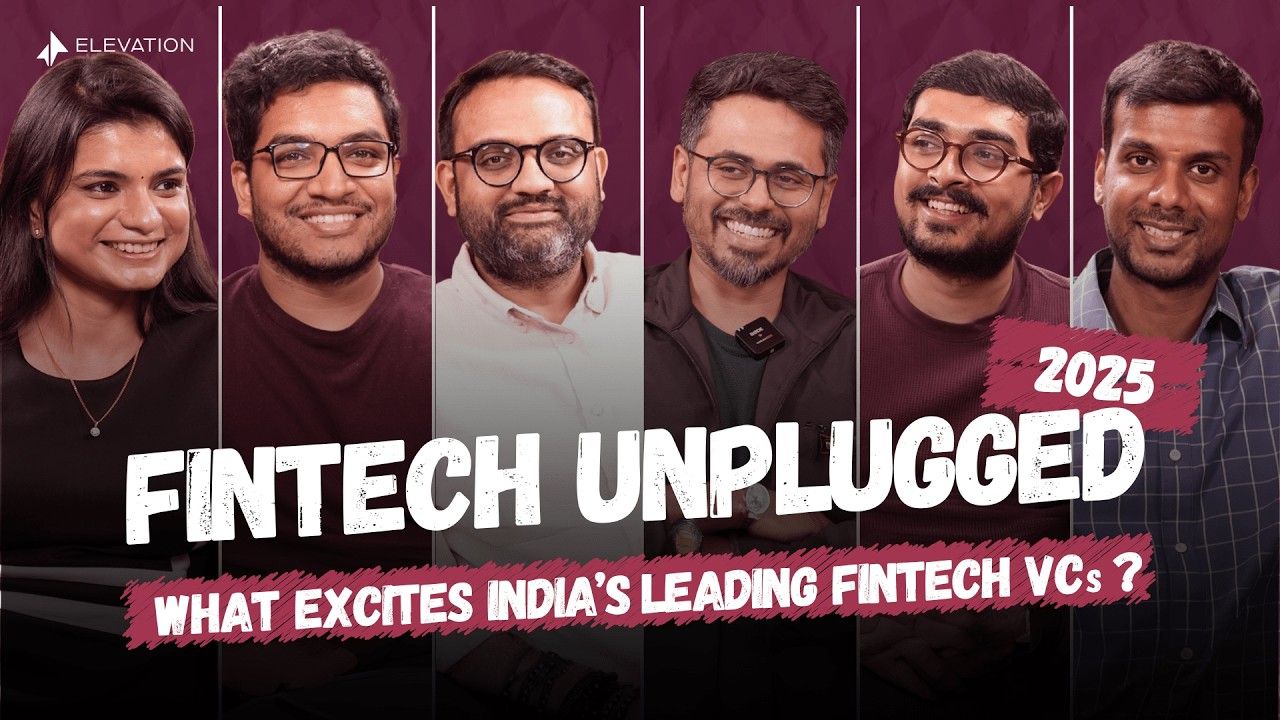
Beyond written research, we brought the entire Fintech and Financial Services team together for a special Fintech Unplugged roundtable, where the team shared their unfiltered takes on what's shaping the future of this space. From the blurring lines between fintech and traditional finance, to the magic of India's DPI story, to opportunities in non-lending areas and the rise of AI in financial services.
We also launched 'Reimagine Everything', a new content series exploring how AI is rewriting the rules of business. We kicked off the series with 'AI Will Create Banks of The Future', exploring how modern AI's ability to think like a knowledge worker and talk like a human will transform bank operations and reimagine customer experience entirely.
Podcasts From Our Stable

Our founder-focused Day One podcast series featured several inspiring conversations this year, offering deep dives into the journeys of founders building category-defining companies.
Our conversation with GreyLabs AI founder Aman Goel revealed their philosophy of being an end-to-end solution provider rather than just a tech vendor. Aman shared how they discovered their first product by shadowing bank field agents for days, why he personally interviews every hire, including interns, and his vision of enabling delightful financial services for 140 crore Indians.
The SarvaGram episode with Utpal Isser and Sameer Mishra offered a masterclass in building for rural India. "The unit is not the individual, it is the household” - this core insight shaped an entirely differentiated rural lending model. They discussed their audacious vision of helping a million households move from one orbit of affluence to another and why any founder building for Bharat must "first go and live there."
Our Sahi episode with Dale Vaz explored how personal obsession with trading led to building a broker that actually helps traders succeed. Dale shared why they decided to build their own chart engine from scratch, the magic of single-screen mobile trading, and how they're building an AI-first company.
The Mahaveer Finance episode with Praveen Dugar and Deepak Dugar offered a masterclass in transforming a multi-generational family business into an institution. Their philosophy that you must "dirty your hands and lose some money" to truly learn used commercial vehicle financing has helped them grow AUM from ₹50 crore to over ₹1,000 crore.
The Scapia conversation with Anil Goteti offered lessons in resilience. When core product issuance was paused due to external factors, Anil made a counterintuitive decision: he invested more in his team and product. When issuances resumed, Scapia emerged not wounded but transformed, with expanded travel categories and deeper partnerships.
Skydo's Srivatsan Sridhar shared how building deep infrastructure before scaling positioned them to become a "cross-border operating system." They've built a platform that eliminates the opacity, delays, and excessive fees plaguing cross-border payments.
Finally, ZFunds founders Manish Kothari and Vidhi Tuteja discussed their contrarian bet that sustainable wealth creation needs human guidance through market cycles, not just cheaper alternatives.
Keep reading
All perspectives →.png?w=1920&h=1126&fit=crop&crop=entropy&auto=format)
AI in Recruitment: A Market Looking For A New Winner Since 2003
Our read on where and how AI can impact the $650B recruitment industry.
05.10.2026 · 4 min read

Insights · Enterprise AI
Why Market Research is Ready for AI
23.06.2026 · 5 min
.png?rect=0,330,1512,960&w=1200&h=762&fit=min&auto=format)
Insights · AI Adoption
How to Go From An Idea to A Prototype with AI: A PM's Playbook
11.06.2026 · 10 min
.png?rect=0,292,1632,1036&w=1600&h=1016&fit=min&auto=format)
Insights · AI Adoption
How to Build an Organisational Brain: A Hands-on Framework by Plotline
07.05.2026 · 14 min
.png?rect=0,388,2180,1384&w=1920&h=1219&fit=min&auto=format)
Insights · Consumer Tech
The Full-Stack Bet: How MiniMax Cracked Both Sides of AI
13.04.2026
